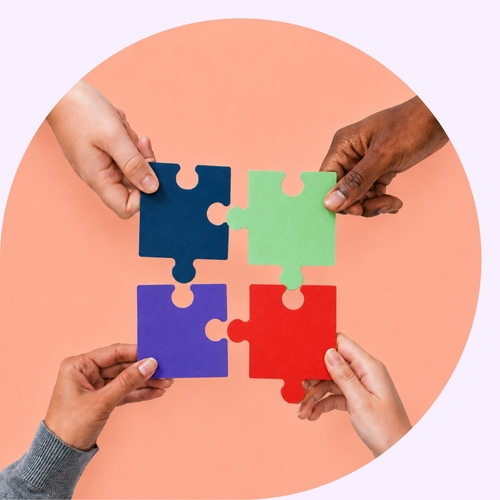
The best work typically carries a lot of different fingerprints. A teammate spots the gap, another adds the customer context, and someone else turns the loose thought into an organized, structured plan. That’s why collaboration is important: it gives your team a shared way to solve problems, make decisions, and move work forward, especially when your team collaboration tool keeps the conversation and context in one place.
What collaboration is (and what it is not)
Collaboration is the practice of people combining their knowledge, skills, and perspectives to create a shared outcome they could not produce as well alone.
This means that teammates are not simply working near one another, adding comments to the same document, or passing a task down the line. They are shaping the work together by offering input, making decisions, and questioning ideas before the team commits to them. The work — and the outcome — belongs to the group as a whole.
Collaboration vs. cooperation vs. coordination
Cooperation, coordination, and collaboration all help teams work together, but they do different jobs:
- Cooperation means dividing the work so each person handles a separate piece.
- Coordination keeps those pieces sequenced, so the right steps happen in the right order.
- Collaboration combines thinking, shaping decisions together and sharing ownership of the final outcome.
Consider the process that goes into launching a product: if design creates the assets, marketing writes the copy, and sales shares customer notes for reference, those teams are “cooperating.” If a project lead lines up those steps so assets, copy, and sales feedback arrive on schedule, then the team is “coordinating.” But if those groups instead come together to shape the message, challenge assumptions, and adjust the plan based on customer feedback, market context, and sales conversations, they are collaborating.
Why is collaboration important for business performance?
The value of collaboration is visible in how the work gets done. Most meaningful projects cross roles, tools, and areas of expertise. When people can contribute early and see the same context, your team can make stronger choices before work gets expensive to change.
This allows for:
Enhanced innovation. Different perspectives expose weak assumptions. A customer support teammate may spot a confusing message that a product team missed. A finance partner may notice a cost risk before a plan moves too far. That useful friction helps ideas get stronger instead of louder.
- Increased productivity. Good collaboration routes work to the people best equipped to move it forward. That can improve team productivity because fewer decisions get stuck with one person, and fewer teammates wait for missing context. Atlassian found that 50 percent of knowledge workers have worked on a project, only to later learn another team was doing the same thing. It also found that 56 percent say teams at their company plan and track work in different ways, making collaboration harder.
- Faster skill development. Team members learn more quickly when work is visible. In real-time collaboration, people can ask questions, watch how decisions get made, and borrow useful practices from teammates in the flow of work. Knowledge becomes easier to share because it is attached to the project, not hidden in someone’s notes.
- Better decisions. Cross functional collaboration helps teams catch blind spots before they become rework. A decision shaped by product, sales, support, and operations usually carries more practical detail than one made from a single point of view. That is one reason why collaboration is important for work that has to hold up outside the meeting where it was approved.
- Stronger engagement. Individuals are more invested when they understand how their work contributes to a project’s success. Strong collaboration supports employee engagement by giving teammates a clearer line between their ideas, the team’s decisions, and the final outcome.
- More trust and resilience. Repeated collaboration gives teammates evidence that they can count on one another. People learn who follows through, who gives useful feedback, and who asks for help early. That kind of trust creates a stronger team culture, especially when plans change and teams need to adapt without waiting for one person to explain every detail.
- Better retention. A positive work environment is about more than perks or policies. People are more likely to stay when they feel connected to their colleagues and proud of the work they create together. Gallup found that employees with at least one collaborative relationship are 42 percent more likely to intend to stay with their current employer for their whole career.
Common collaboration challenges — and how to address them
Collaboration can go wrong when teams confuse “participation” with “progress.” A packed channel, a crowded meeting, or a shared document with dozens of comments may look active, but activity is not the same as useful contribution.
Activity is not the same as useful contribution.
As you work to prioritize collaboration, be aware of these potential pitfalls:
- Groupthink. Agreement can arrive too quickly when people do not want to slow the group down. Build in structured debate before major decisions. Assign someone to test the plan, name tradeoffs, and raise the objection the team may be avoiding.
- Uneven participation. Group work can hide unclear ownership. Some people carry too much; others drift because no one has named where they are expected to contribute. Effective collaboration pairs shared outcomes with clear individual responsibility, so every teammate knows what they own and where their input is needed.
- Communication barriers. Time zones, unclear roles, and too many tools can all weaken collaboration. Zoom found that teams using more than 10 apps were twice as likely to spend an hour or more resolving collaboration issues compared with teams using fewer than five apps. Its research also found that 32 percent of leaders and 33 percent of employees named a lack of shared direction between or within teams as an outcome of ineffective collaboration.
- Knowledge gaps. The right internal communications strategy helps people understand where decisions live, which channels to use, and how updates should be documented. Without that structure, barriers to knowledge sharing grow quickly: a decision sits in a private thread, a project update gets buried, and a new teammate cannot find the context they need.
- Sync and async confusion. A clear approach to synchronous vs. asynchronous work keeps collaboration healthy. Live conversation is best for urgent decisions, sensitive topics, and creative working sessions. Delayed communication works better for status updates, documentation, and input across time zones.
Psychological safety is the thread running through all of these issues. People need to know they can disagree, ask basic questions, and raise risks without being treated as “difficult.” Leaders set that tone by responding well to bad news, welcoming constructive feedback, and giving credit to the person who spots the gap early.
Collaborate effectively with Slack
Collaboration gets easier when everything operates out of a single, centralized space. Slack brings people, conversations, files, apps, and decisions into one place, so teams can move between quick questions and deeper work without losing the thread.
- Channels give every project, team, or topic a shared home, so conversations and decisions are easier to find later
- Slack supports live and async communication, helping teams collaborate quickly when needed and document updates when focus time matters
As a leading team collaboration tool, Slack helps teams spend less time searching for context and more time contributing to the work. Global Slack users reported a 36 percent improvement in the time it takes to complete projects and a 33 percent decrease in time spent in meetings, based on average reported outcomes.
Why is collaboration important? Because the faster your team can find the right people, context, and decisions, the faster your team can turn effort to effective outcomes.
 |
Try Slack for free todayWhatever work you do, you can do it in Slack. Get the power and alignment you need to do your best work. |
Why collaboration is important FAQ
 훌륭해요!
훌륭해요!
피드백을 주셔서 감사합니다.
알겠습니다!
피드백을 주셔서 감사합니다.
죄송합니다. 문제가 발생했습니다. 나중에 다시 시도해주세요.